
So, all that follows here is because I had my Windows laptop repaired and I can model antennas again. That, and a cedar-fever head cold that kept me out of the park all weekend converted my schedule into deep-diving into full Ham Nerd. SIQ, Sick In Quarters.
The software is MMANA-GAL, the basic version is free. If you’ve watched ANY of my park activation videos, you’ve seen these antenna systems at work. Here’s what I’ve modeled for us:
- 20m Flat Top Dipole
- 20m Inverted V Dipole
- 20m 1/4 Wave Vertical
- 20m EFHW
- 20m on a 4010 EFHW Sloper
- 20m on a 4010 EFHW Inverted V
20m Dipole Flat Top Dipole (Back To The Top)
This is the basic antenna from which all others are compared. But unfortunately, not really. The dipole we consider a standard is isotropic – calculated without the earth around it. As portable ops, we’re very much concerned with the earth around us and how it effects both performance and deployment. Proximity to the earth greatly changes the radiation pattern of a dipole.
For the purpose of this discussion, I’ve modeled this dipole as if I’m using 10m masts. Imagine three – one in the center for the feed point and one for each leg. There’s no way I’m willing to raise three masts for a park activation, but I might for field day, or an actual emergency event.
I shifted the model optimization around between SWR, Gain, and reactance jX, with no noticeable effect on plotted gain. So, it is what it is and there ain’t no more.
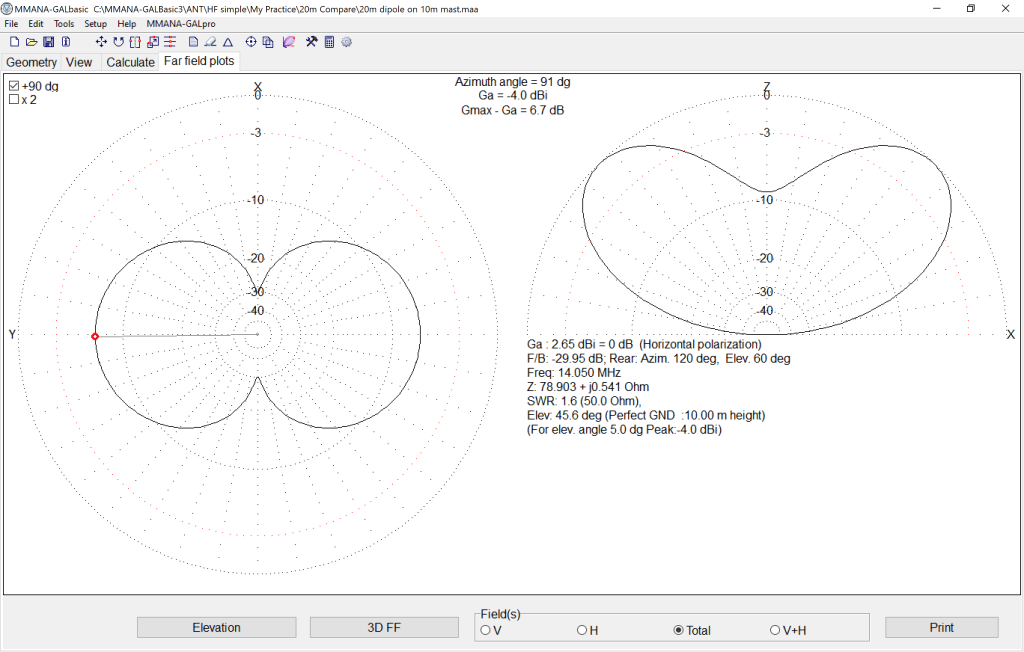
The 20m flatop dipole, overall, radiates broadside or perpendicular to the wire. With the majority of its horsepower at about 45 degrees off of the horizon.
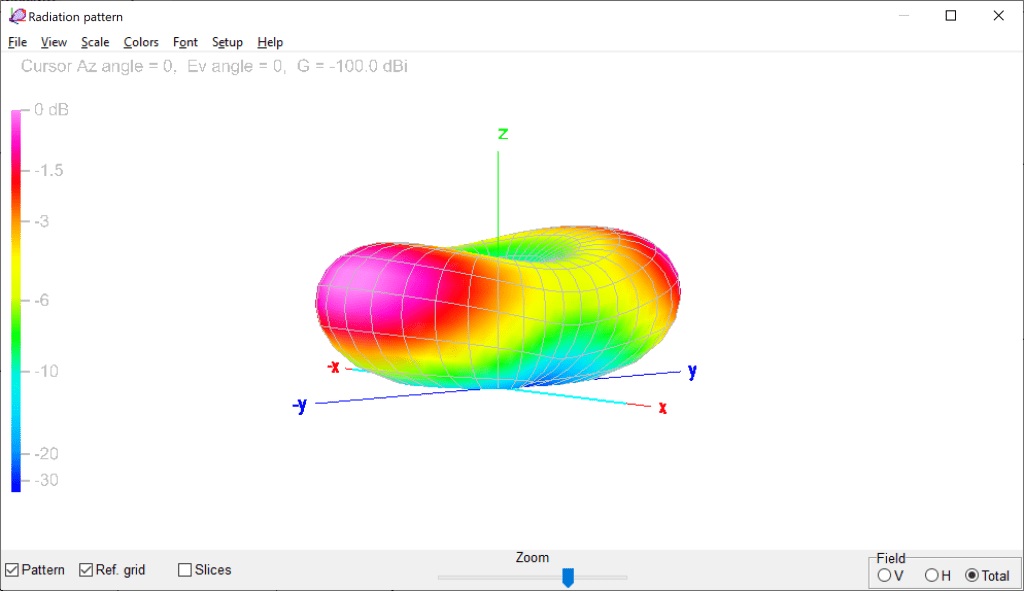
At 5 degree off the horizon, most consider 5 – 10 degree above the horizon optimal for DXing, the broadside plots -4dBi with narrow nulls at the ends of the wires.
20m on a dipole, inverted V (Back To The Top)
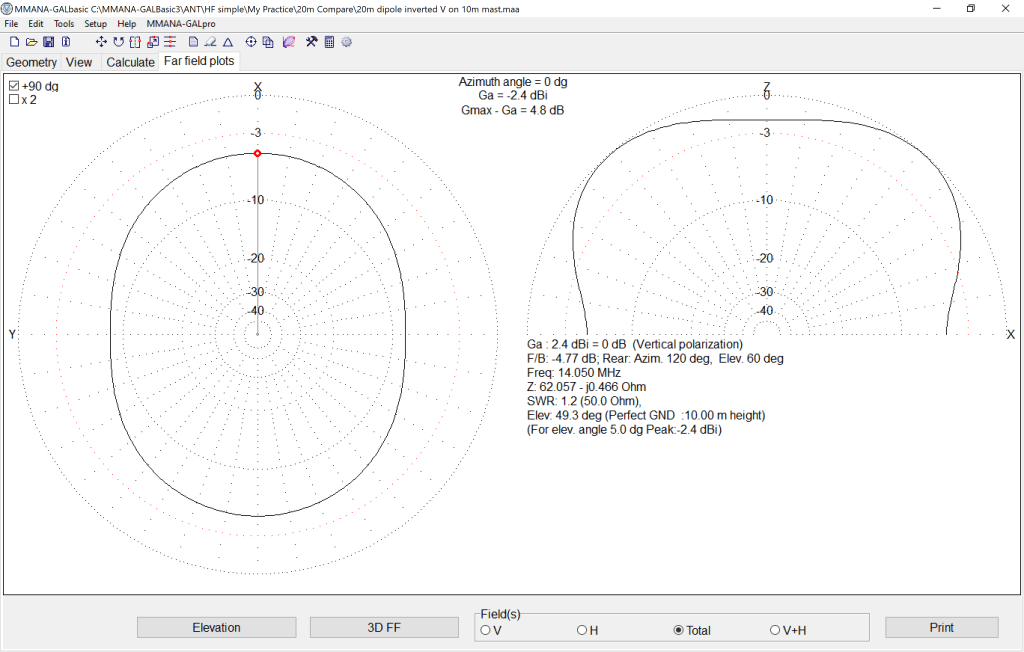
A 20m dipole up 10m on a mast, in an inverted v configuration. Each leg slopes down at 45 degrees from the horizontal.
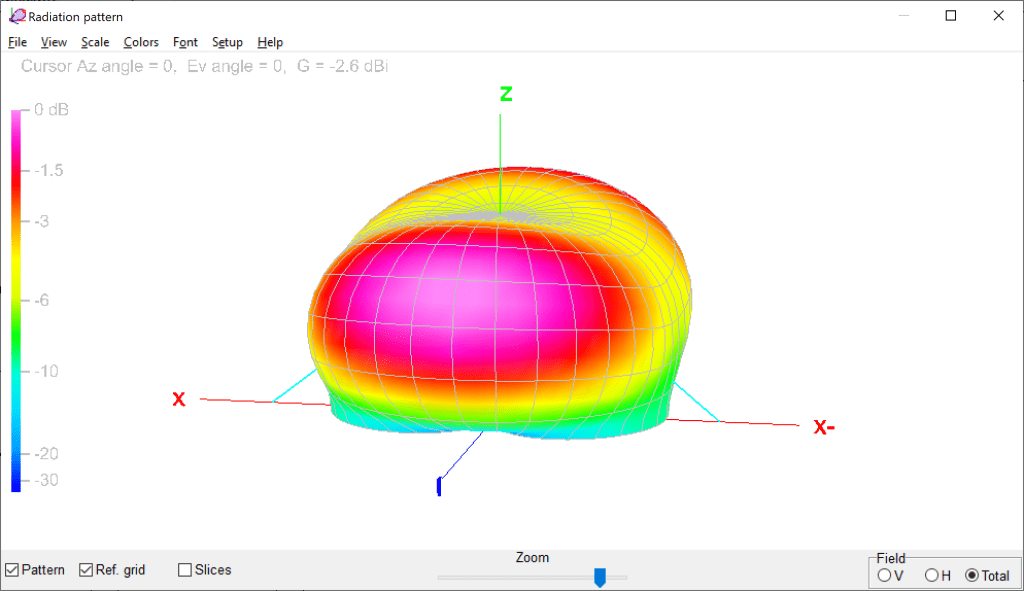
It models with 6dBi of gain at the broadsides, but down at 5 degrees off the horizon, it plots -6dBi. Oddly, the gain shifts to the ends of the wire with -2.4dBi radiating from the wire ends.
20m Vertical (Back To The Top)
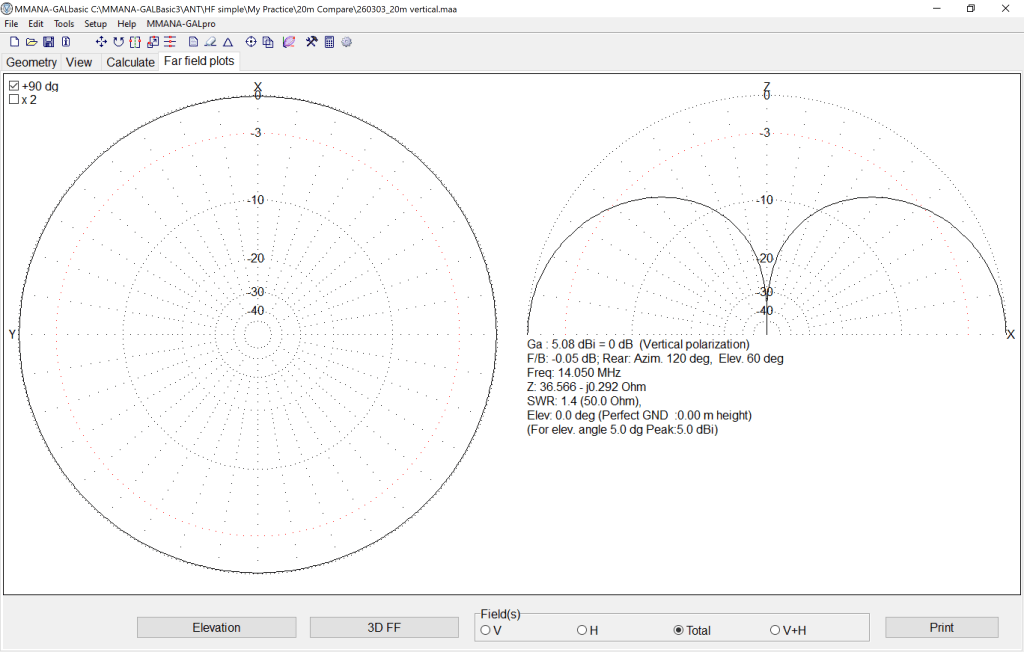
A ground mounted vertical with 12, 1/4 wavelength radials as ground plane. The radiator is optimized for best SWR. We can optimize the model for gain, but that solution yields an unacceptable .42m radiator and 798087:1 SWR. Setting the optimization priority between resonance and SWR, results in a 5.18m radiator with SWR of 1.37:1 and reactance jX of -.29 ohms.
We have to assume a choke at the feed point to eliminate a common mode counterpoise (the coax shield).
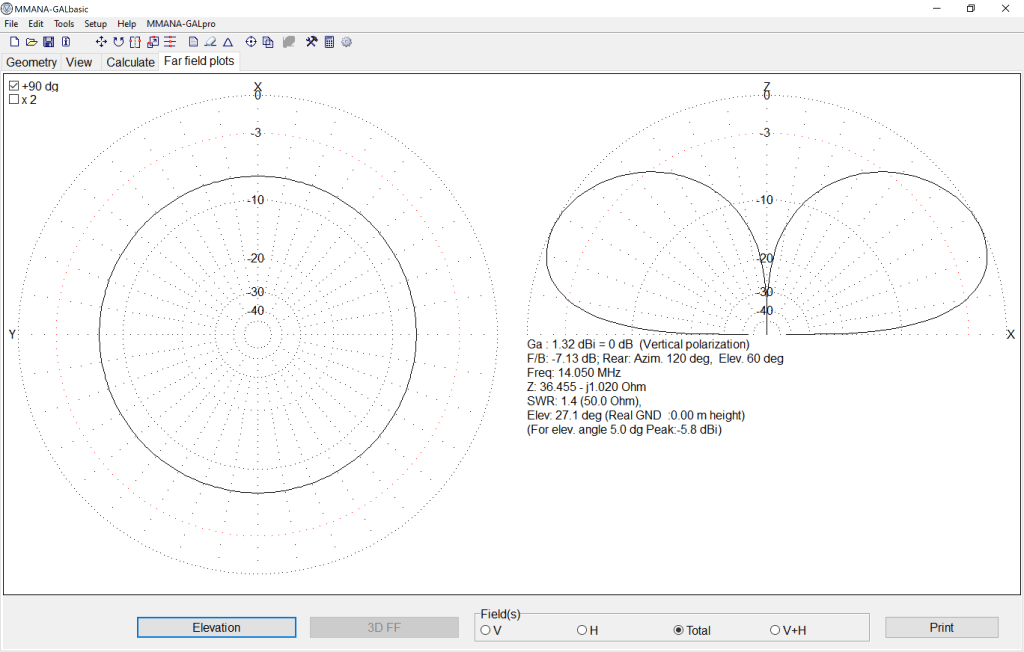
This vertical is omnidirectional with 1.3dBi gain in all directions, -5.8dBi at 5 degrees off the horizon. This is the simple vertical.
20m EFHW (Back To The Top)
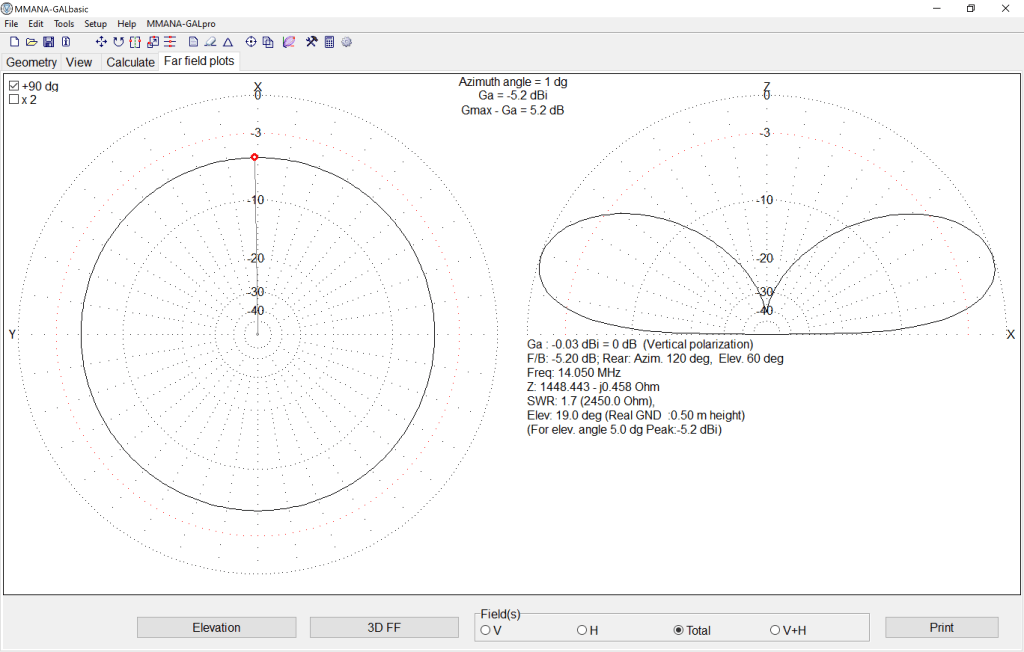
The wire hangs from a 10m mast with the feed point about 2 feet off the ground. The radiator and counterpoise are optimized for lowest SWR.
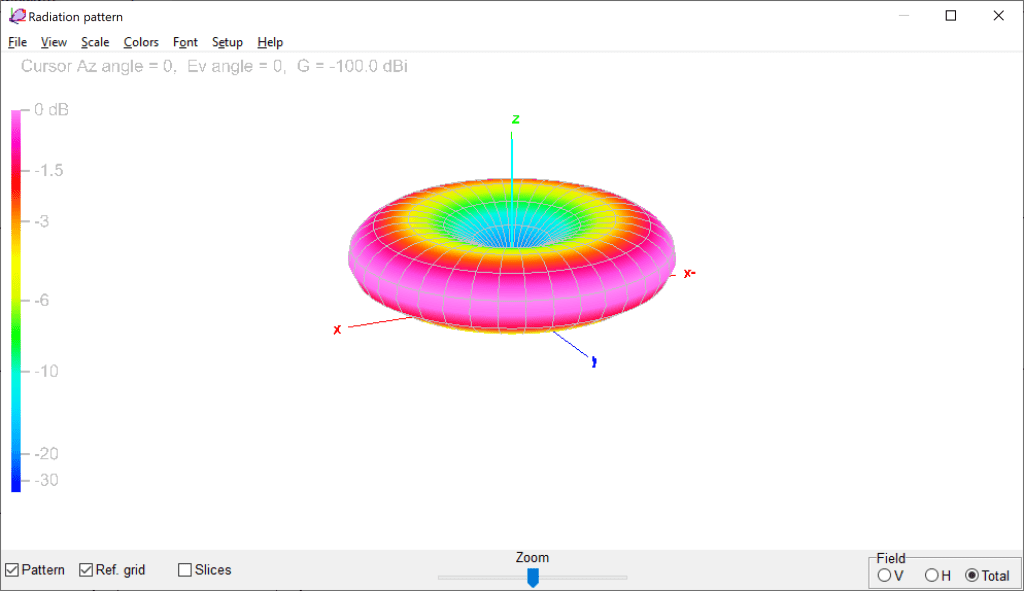
The pattern is an omnidirectional donut with -5.3 dBi of gain at 5 degrees above the horizon.
There’s a slight , -5.2dBi, in the direction of the tuned counterpoise.
20m on 4010 EFHW Sloper (Back To The Top)
This is a 20m wire with a 49:1 UNUN transformer at the feed point. Let’s assume the wire is tuned for 40m. We can also assume we can find a workable impedance match on the multiples of 40m – 20, 15, and 10m.
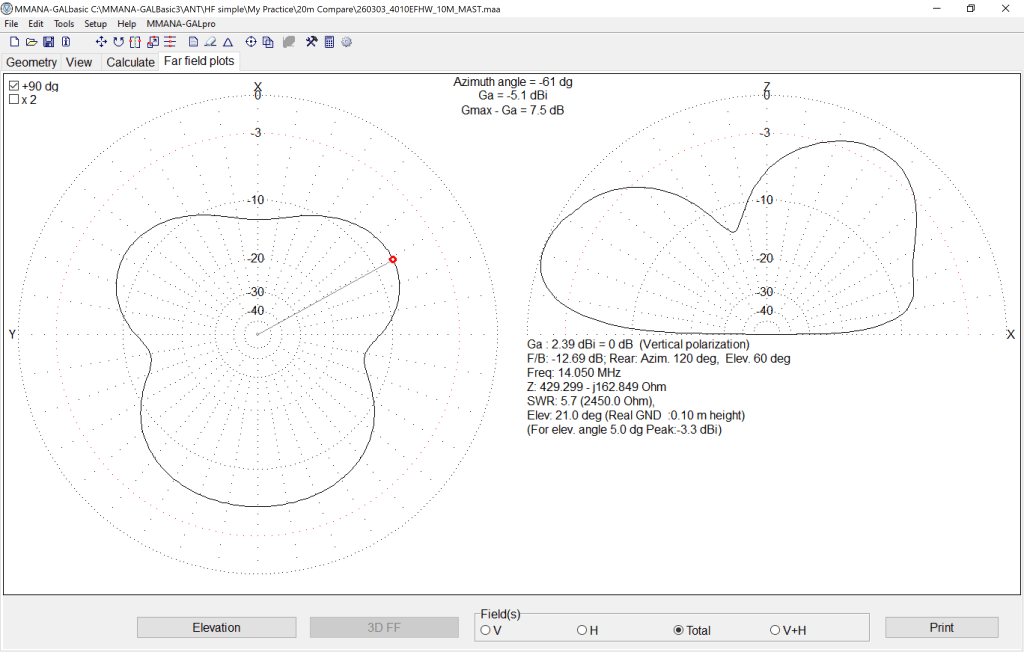
The radiation pattern shows lobes and nulls meaning, we’ll need to account for the orientation when we deploy it.
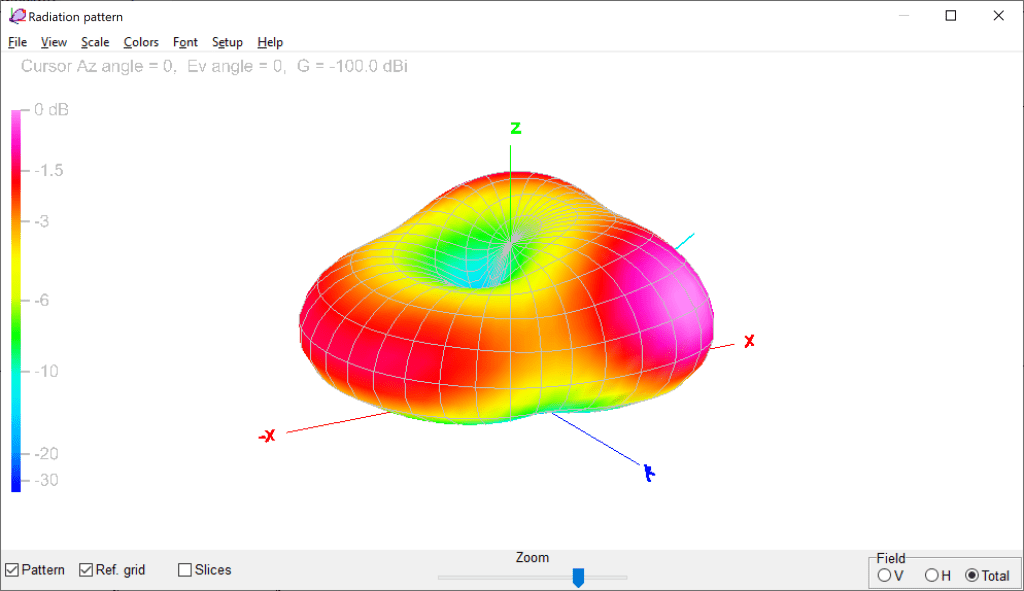
At 5 degrees off the horizon, the focus of radiating power is behind the feed point giving about -3dBi for about 30 degrees. In the other direction, away from the feed point, there’s mild “micky ear” lobes pointing out 45 degrees from the axis of the wire at -5.1dBi at the strongest point.
20m on 4010 Inverted V (Back To The Top)
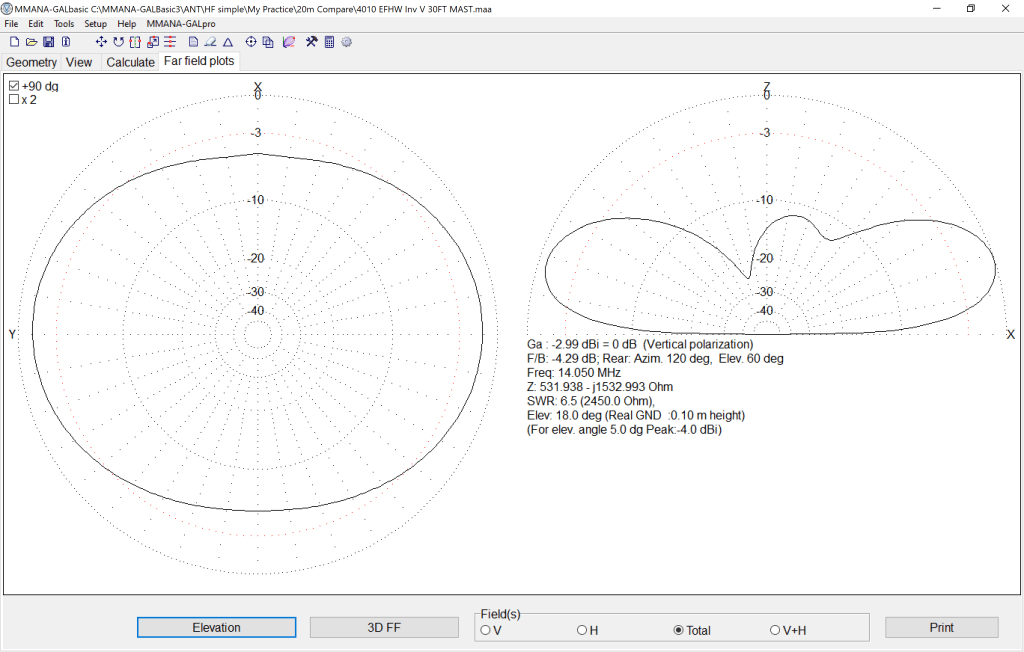
Interesting how the sloper above radiates along the axis of the wire but as we’ll see below, the inverted v radiates to broadside. Like a dipole but without the nulls.
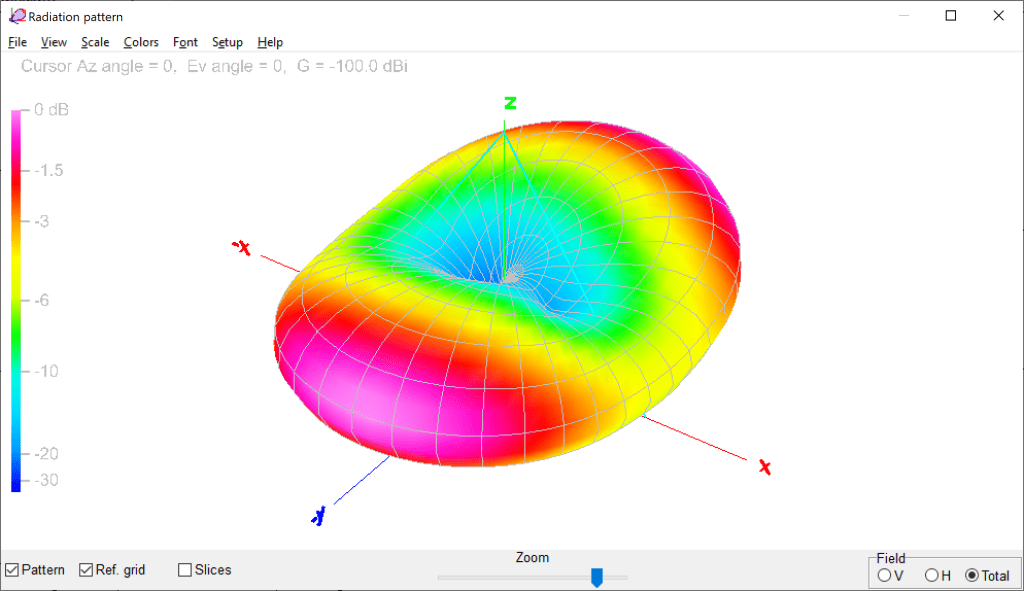
But the broadside radiation is more up than out with a 5 degree DX take off angle peaking at -4dBi
Conclusions
Admittedly, there are several 20m systems perfect for portable ops that I haven’t modeled here – the OCF Dipole and delta loop come to mind. But something I’ve really learned here today, is that the results of the models don’t align with the opinions I’ve formed from over 500 Parks On The Air activations.
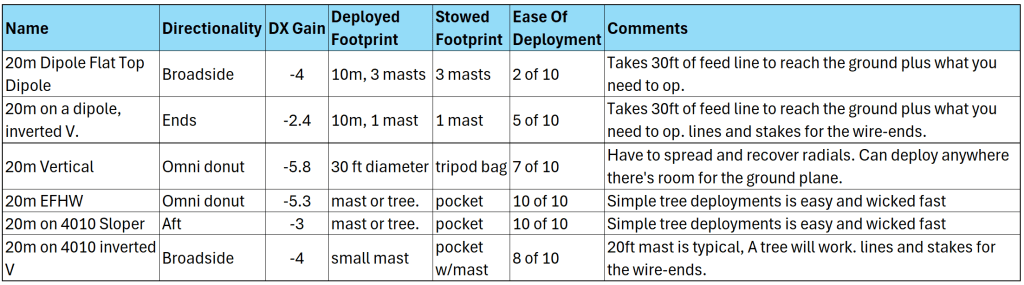
For example, the 4010 EFHW as a sloper and as an inverted V are great systems. My most reliable. But based on these model, they stink! I’ve always loved the 1/4 wave vertical but for some reason, just don’t go with it very often. I started relying on smaller lighter stations for CW. Is the Vert not that great, or does the size and complexity of it make it harder for me to appreciate?
The 20m EFHW, run straight up is my very favorite for single-band ops. It’s a blink to deploy, has great ears, low noise, and can reach anywhere in North America.
On the other end, the 1/4 whip vertical is admittedly the most versatile system, but I’ve never considered it worth the trouble of the ground plane radials. It models -5.8dBi gain in all directions. How could I not notice this?
I find transferable objectivity here, almost impossible. Meaning, we can strive for objective analytics within this swirl of subjectivity – the sun, the atmosphere, the QRM, the soil, the trees and on, and on – but anything we conclude is not transferable to anyone else’s spaghetti bowl of subjectivity.
The conclusions of the models do not align with the evolution of opinions I carry with me. More than performance, no model can account for my perspectives on complexity, ease or difficulty of deployment and recovery, footprint in the park, or footprint in my pocket, pack, and car.
So is there any hope of ever defining the best antenna for 20m portable operations? Apparently not. Does it really matter if we just use whatever works? Probably not as much as some would have us believe. I think I’m coming to understand that the threshold of “it sucks don’t use it” is miles below the -5dBi poop wagon my go-to wire shows here.
Further, it’s common to evaluate an antenna’s gain at 5 degrees off the horizon and I’m not sure of the real-world value of that metric as the sole indicator of performance. Especially for POTA where DX is fun, but not the goal for most.
I see this conversation similar to the countless conversations I enjoyed with precision shooters and handloaders. For a rifle that will consistently group 5 shots into a single, egg-shaped hole, two tenths of an inch of slop is a deal breaker. But, for the rest of us, that .2-inch error is in the middle of a 3-foot square target.
So, if you want the best of what’s modeled here, all of them are way better than good enough for POTA.
TNX ES 73
KA5TXN
DitWit


 DitWit Portable Radio
Leave a comment