I’ve tumbled into the Crafty Nerd side of amateur radio and I blame it mostly on my good friend W5DRT, David. He innocently started winding impedance transformers for end fed wire antennas and that’s all it took to send me careening down the slippery slope of ham radio DIY. David took the path of 49:1 so I took the other trail to the 9:1.
The post’s title 9:1 Second to None isn’t true. It just rhymes. The 9:1 is second to allot of other options, but I like it none the less. As a /P op, it’s the versatility that really promotes the humble random length end fed to the top of my load plan. It lets me get a vertical radiator up without all the ground plane fuss – long-ish wire and little box with a counterpoise.
I’ve tried my hand on a 49:1 transformer a few times with some modest success but the building process taught me a few things. Chief among the lessons learned was, “Just buy one from a pro builder.” I’ve bought plenty of “pro-made” transformers to 1, get me on the air, and 2, serve as standards of comparison for my own builds. In the 9:1 department, I bought an LDG. Junk you say? Probably… maybe… but they work and they’re affordable enough that I always have two – one to use and one to give a friend. And as my own builds have evolved, the LDG under the discerning eye of a NanoVNA has proved invaluable for showing the nuts and bolts of a transformer that works.
The 9:1 seemed a little intimidating. Instead of winding one wire, your’re winding three at the same time. That’s been enough to keep me away from it for about three years. As it turns out (no pun intended), it’s really easy to make a truly effective 9:1 impedance transformer for your end fed random wire needs. I’m not writing a “how to” – rather, I want to give you a “you can”. You can make a 9:1 transformer that is as good or better than anything you can buy.
I use the image below just for the terminations. The number of turns it shows won’t work on any toroid smaller than a tractor tire.
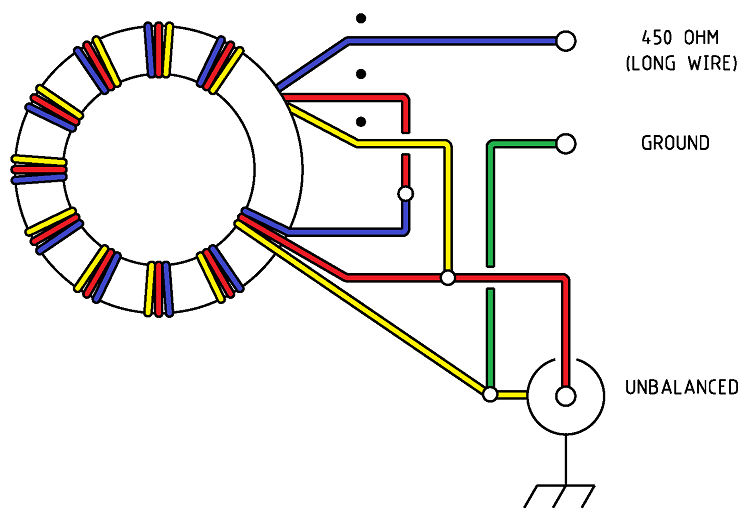
Just don’t follow all of what you see on the Internet about how many turns. On my first attempt, I just filled the toroid making it look like the pictures. My trifilar turns (groups of three) were touching all the way around the donut, but not jam-crowded. With a 450 load on it SWR was about flat at 80m then took off climbing at about a 45 degree angle exiting the top of the graph somewhere between 20 and 15 meters. Fail.
A sprint of Internet clicking evolved the idea that wraps too close together would couple capacitance.
So, how many turns? Less than my first try. I consulted the Internet and experts suggested 9 trifilar turns. Again, a fairly spectacular fail according to the Nano VNA. SWR didn’t rise as sharply, but you’d still run out of tuner before you ran out of amateur bands.
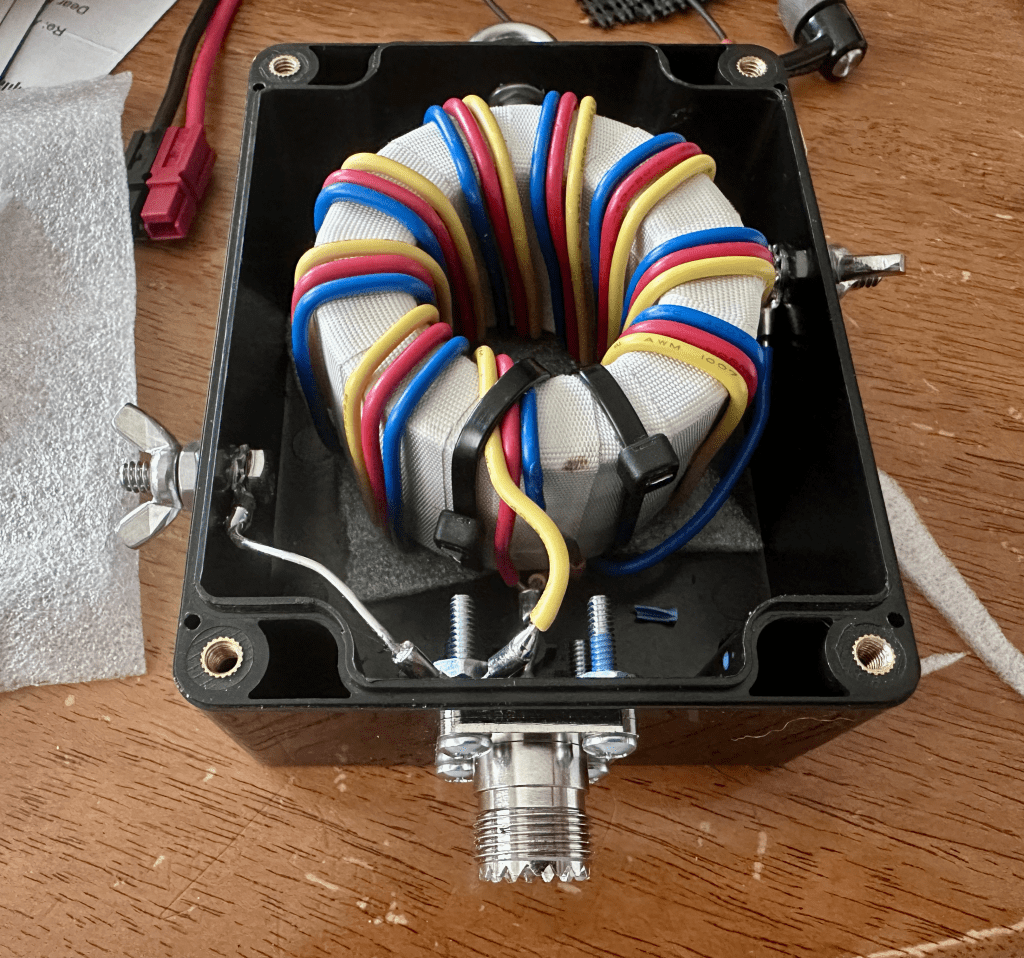
Giving up on Internet experts, I turned to the commercial experts and took the cover off of a My Antennas 9:1 that I know works How many trifilar turns? Four. That’s it. Four lousy turns on a great big toroid. Heck, compared to mine, their wraps are hardly in the same county.
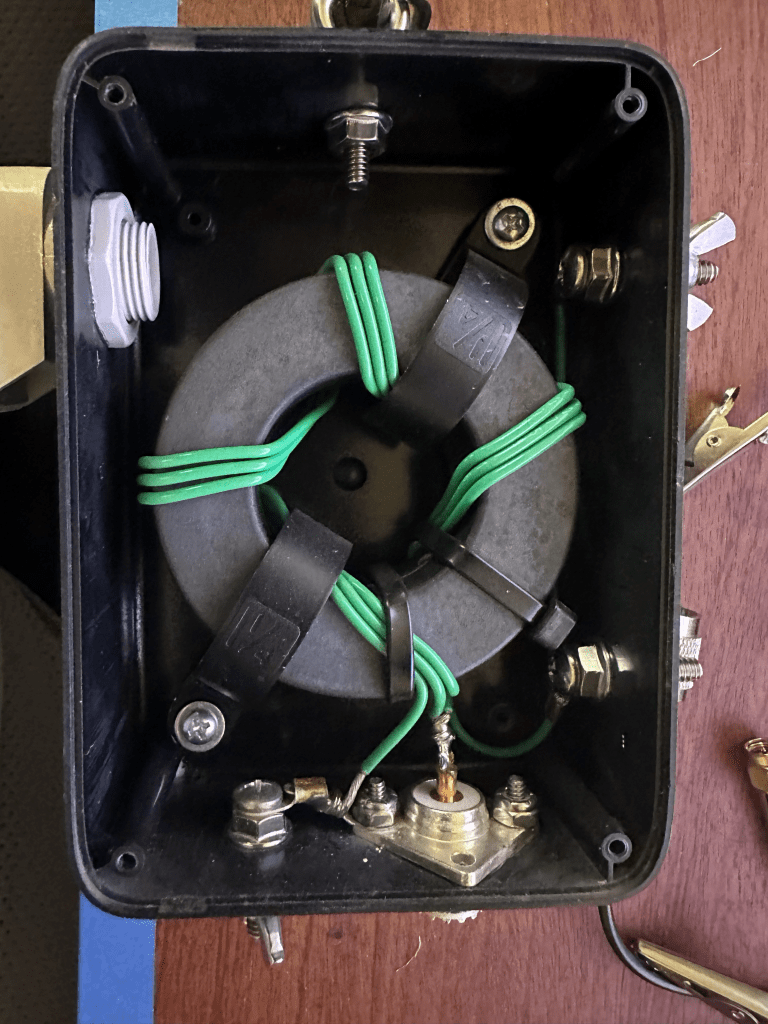
Now, contrary to best practices, I changed two things at once. I changed the number of trifilar wraps, and I changed toroid. Instead of the 140-43 toroid, I changed to the 2643251002. My goal had shifted to include some power handling and the chunkier 1002 has much more thermal mass than the 140-43. My ditching Fault Isolation best practices should tell you I’d all but given up and this attempt was my Hail Mary. The 1002 has a smaller inside diameter, so I decided on three wraps.
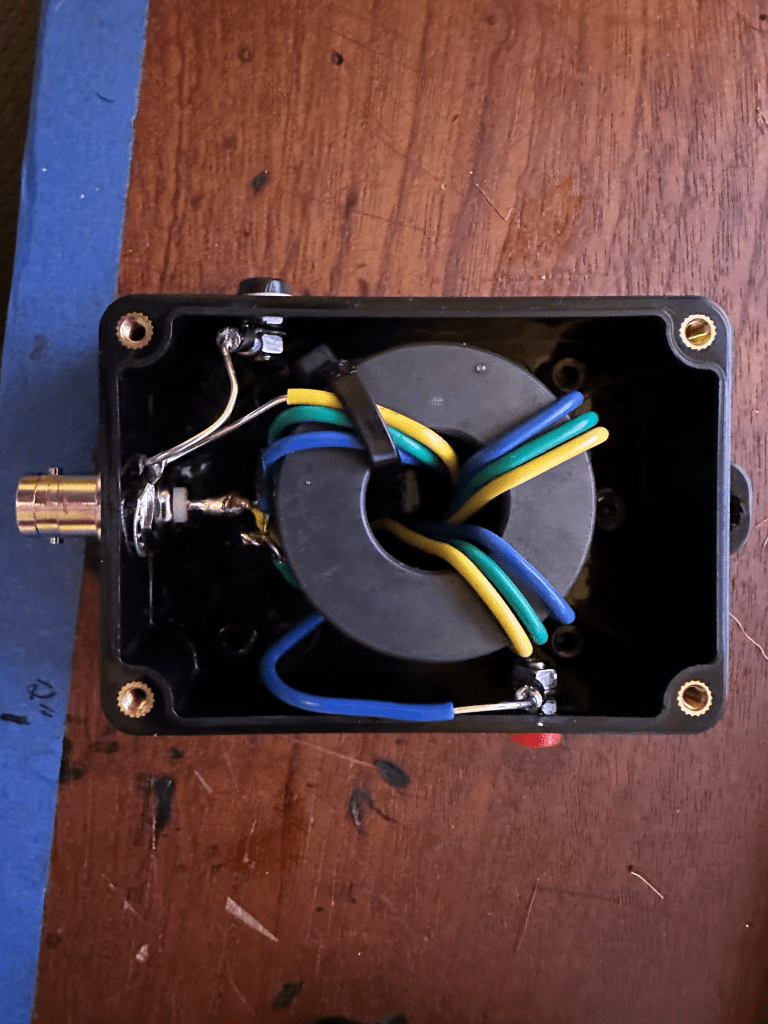
It looks dumb. And it worked! Three wraps. But that’s just the first part of the experiment, making it work. The second part is, is it working as well as what I can buy. To answer that, I plotted SWR of this “TXN” transformer and compared it to some store bought ones. If you’re new to this or have aging eyes, SWR plotted low and flat is best.
Before we get too far into the plots, understand this is “as tested” not “as fielded” performance. I mean there are endless factors that influence measured VSWR so any test bench numbers only represent a relative or ballpark indication. But it’s plenty good enough for rainy days and blog posts.
Matching (SWR)
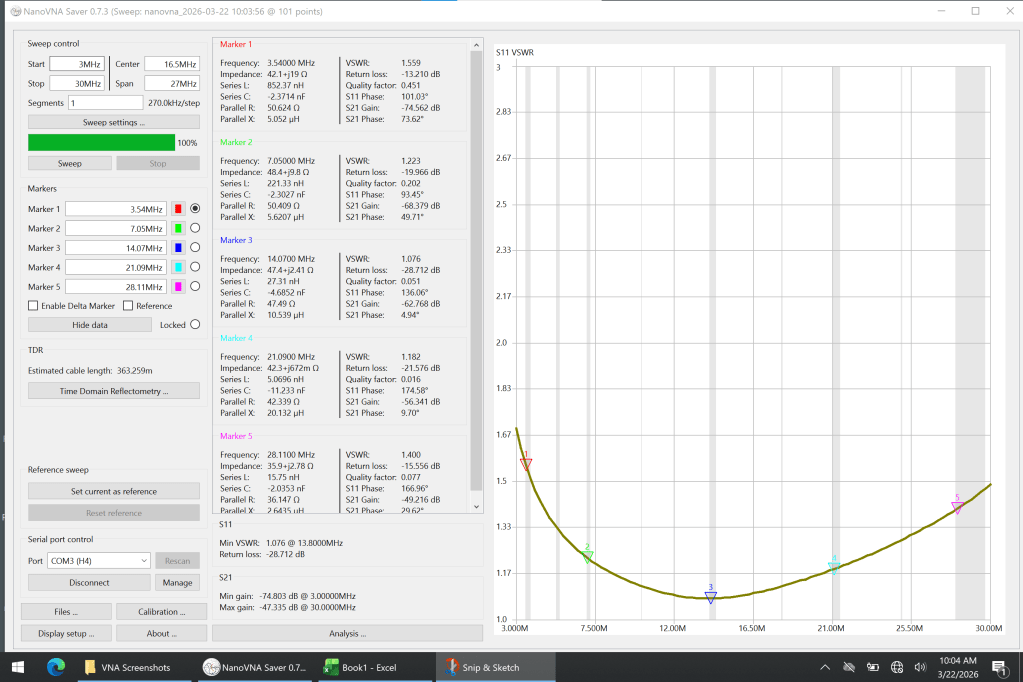
With a 450 ohm load between the radiator and ground terminals, the LDG transformer plotted completely useable with 40 to 15 meters well below 1.3. It rose a little higher on the extreme ends, 80m and 10m but again, all would easily be in range of the laziest ATU and “safe” without any tuner at all. Remember the look of this graph – it’s what we’re trying to beat.
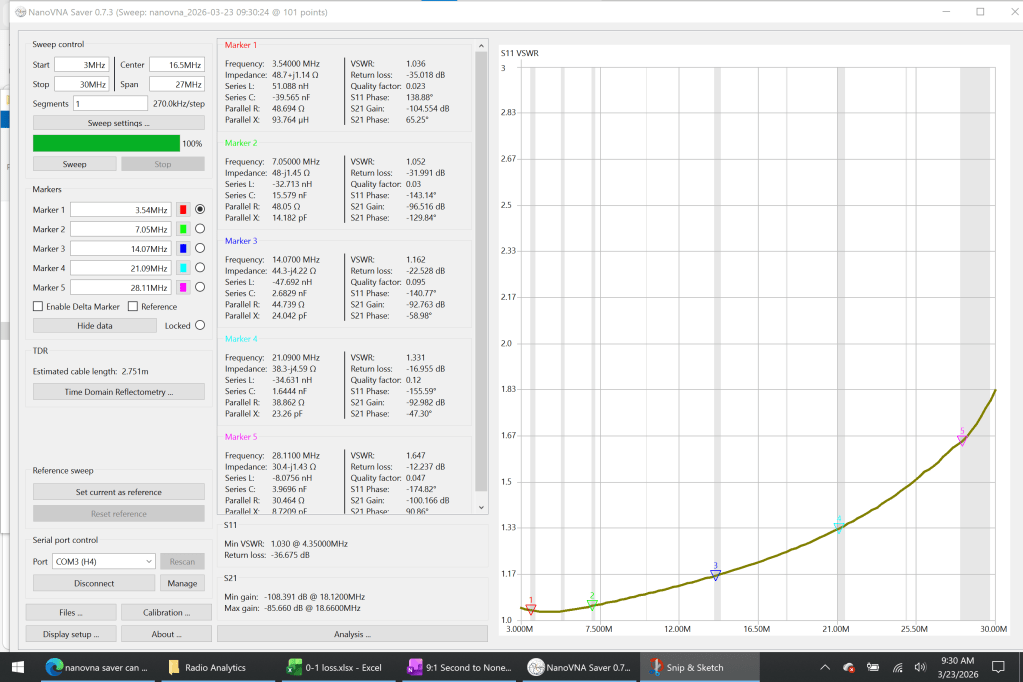
The My Antenna had a different look, as if the toroid mix is best suited for 20m and below with the best match at 80 meters where it’s impressively flat. 10 meters creeps up close to 2:1 at the top of the band where all the gum-bumping happens.
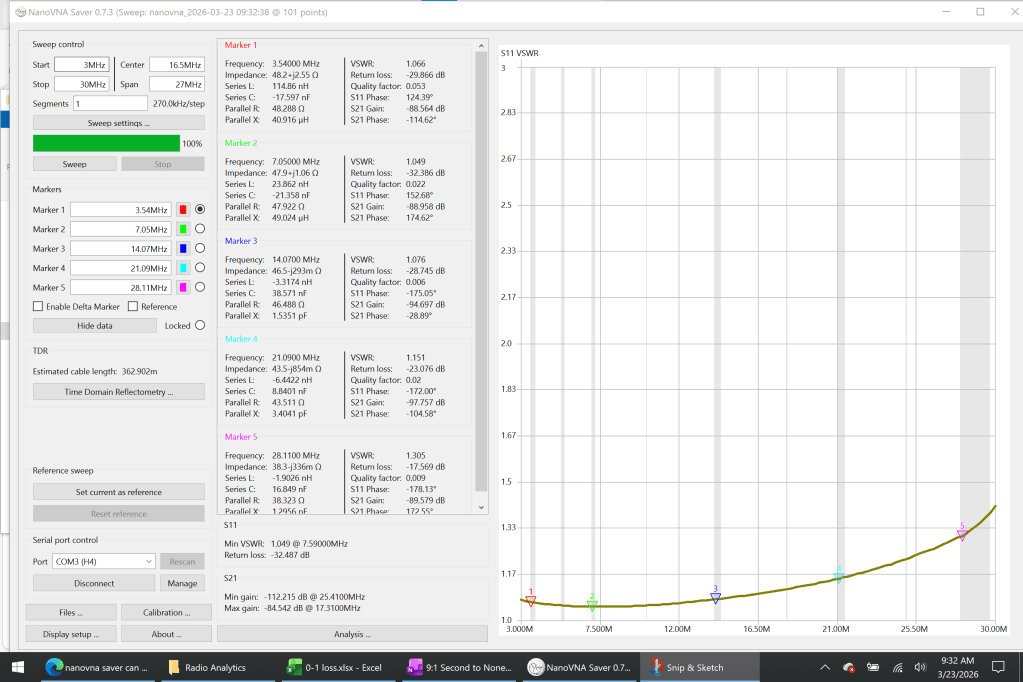
The TXN (my version) is an impressive best in category matching 80 to 10 meters well within the “safe with no tuner” range. Why? Beats me, and if you don’t know why, it’s not a win – it’s just a process of elimination. I stopped when it worked. But the three wraps, down from 9, seems to have negated the capacitance coupling.
Insertion Loss
VSWR is just part of the picture, though an admittedly important part. The other concern is loss. Loss represents power that doesn’t make it out of the radiator. Your transmitter power is useless if it gets cooked off as heat on the way out.
We call it insertion loss and we measure it with a Nano VNA on two transformers wired back to back. A signal from the VNA travels through the first transformer, into and through the second one, then back into the VNA through a second port. The VNA compares the power of what it sent out to the power of what came back and represents the value as gain. Negative gain is loss.
Again, using the LDG as the “gold unit” baseline or standard, we see some loss as frequency increases with a cliff at the bottom of 10 meters.
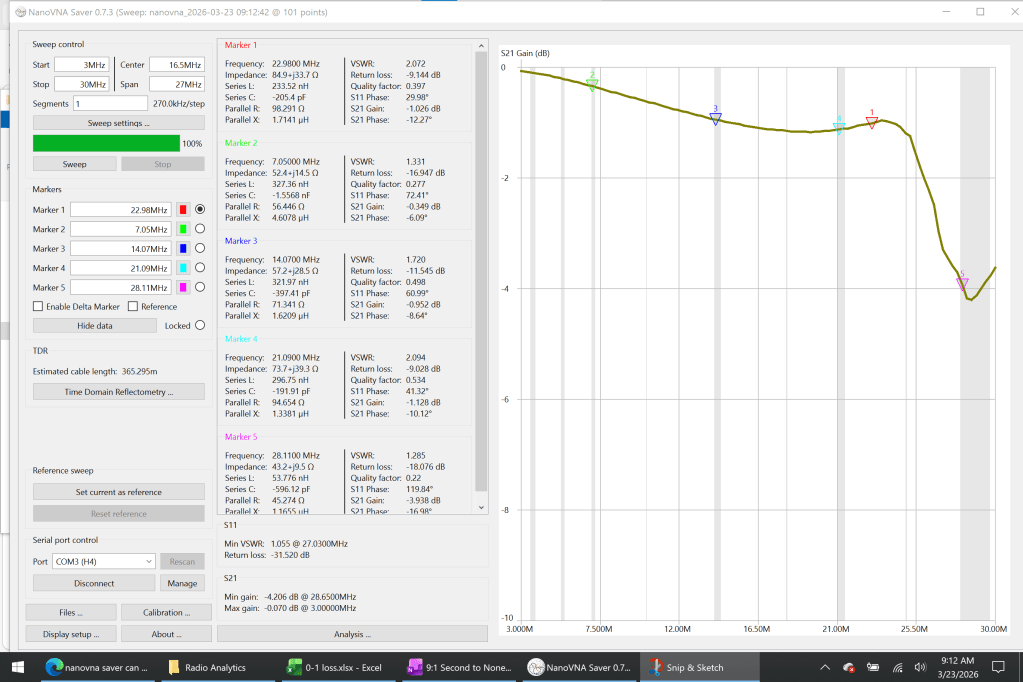
I don’t have a second My Antennas transformer so I couldn’t get a back to back test. Loss on my TXN version looks like this. It looks very, very similar to the LDG so I have to assume that this loss is a result of the toroid material. Our 1002 is a 43 mix.
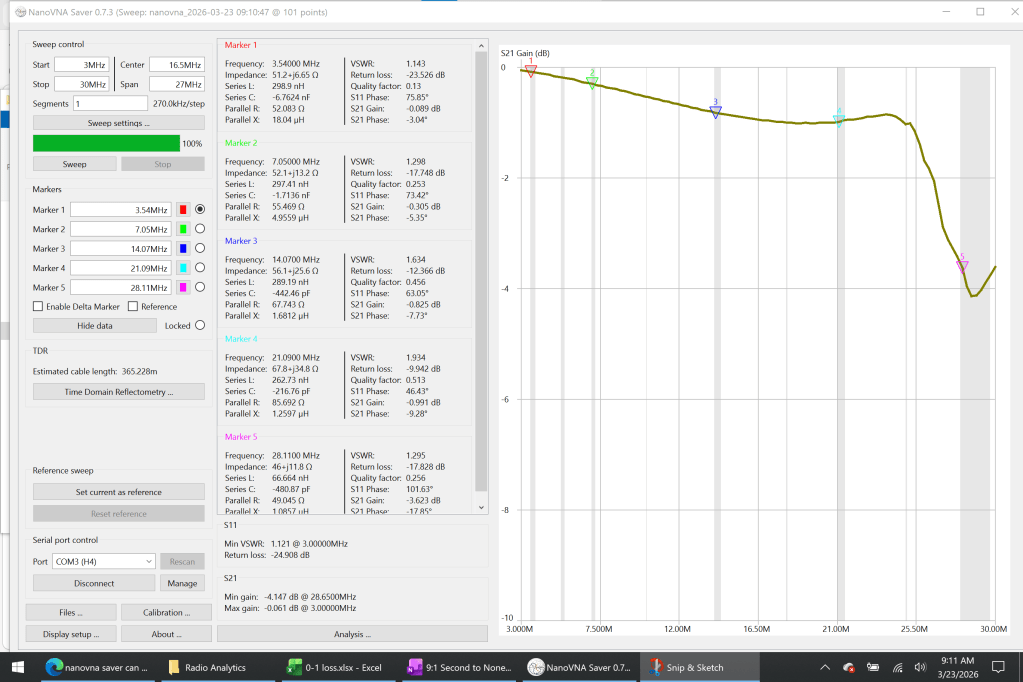
The loss plotted is the result of two transformers, back to back, so we divide the results by two, to present the loss from a single unit. Converting these measurements of loss into calculated efficiency and the table below makes a somewhat apples to apples comparison.

Understand that 77% efficiency means 2.3 of your 10 watts are cooking worms. Yum. But if you think 77% efficiency on 10 meters means you can’t make contacts, you’re mistaken.
Conclusion
It’s important to agree that what we calculate on a test bench is not what happens in the real world. While it’s a reliable model for analysis, things are different when you put full power on them. Ever put your rig on 5w, use a manual tuner, then see the needles move differently when you goose it up to QRO? So I’m careful to say, with all things considered the same, this is a relative comparison between the LDG 9:1 and my TXN 9:1.
The TXN 9:1 has markedly flatter SWR across the HF bands. That means little or no tuning necessary on those frequencies producing 450 ohms of impedance.
Loss? Yep, the TXN beats the LDG there, too. But to such a slim margin we would absolutely positively never know the difference.
What it really means to me is that once again, I beat the system by making something I’m supposed to buy. The LDG costs about $35. But I’m no sucker – I bought 10 toroids, several spools of wire, and three or four project boxes until I found the one I like. I purchased and experimented with a wide variety of bolts, washers, eye loops, and wing nuts. And don’t forget my labor. Regardless of the hourly wage, I put some real time into this. But did I win? Did I stick to the man with my DIY transformer?
Here I stand with this blog post in one hand and a probably $600 UNUN in the other. Hell yeah I won.
TNX ES 73
KA5TXN
DitWit

 DitWit Portable Radio
Leave a comment