
So, in every antenna conversation I have in my mind, there’s an old guy in the back who keeps interrupting with, “Use a dipole!”
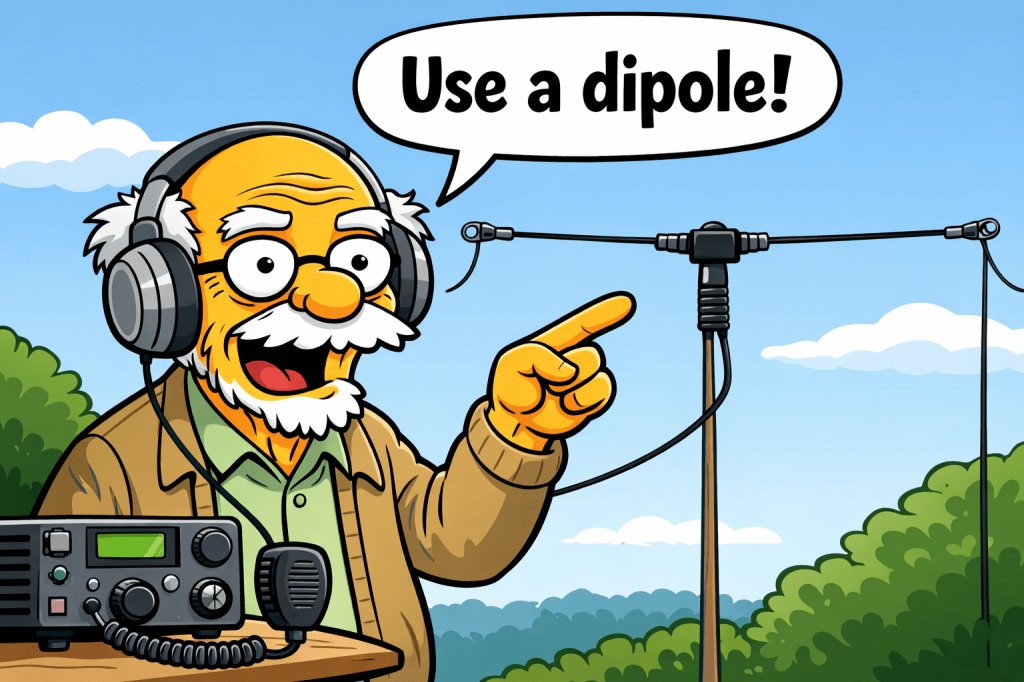
To me, that juice just ain’t worth the squeeze for a portable guy. Getting it up to ¼ wave will take 33ft of feedline. Then, what do I do with the two radiators? Two more masts? Two trees, a half wave apart with no obstructions in between? Too much feedline, too much trouble. And that’s where the dipole sits in my mind – in the back of the room with Grandpa Simpson.
I was driving somewhere and listening to the All Portable Discussion Zone podcast (which I recommend). The guest was some super duper SOTA GOAT who said he pretty much always uses a dipole because he’s just working one band. I’ve heard this many times so, whatever floats your boat, dude.

A few moments later, he casually mentioned that sometimes the only mast he has is a trekking pole and just puts his wire in an inverted V. No muss no fuss works fine. Stop. Cue the screeching brake sound – a trekking pole? I’ve used an inverted V with an end fed half wave many, many, times, but my brain never connected that to a center fed dipole possibility.
It has now. I’ve had smashing results with my 40-10 EFHW in inverted v (66-is feet of wire) with the center raised on my POTA20, 20ft carbon fiber mast. Super convenient, works great. Why not a dipole, which is…wait for it…66-ish feet of wire? Incidentally, we should call it “Caret” instead of inverted V. IYKYK
So, I made a 30’ length of RG-316 feed line. I used my fishing pole holder thingy and raised my 20’ POTA20 in the back yard. I used a female BNC to Binding Posts adapter and cut some wire.
I used 20 AWG BNTechGo silicone insulated wire. And it was 2P wire, meaning two wires together like speaker wire. This meant I could cut the length for one leg (1/4 wave), separate them, and I’d at least start with both radiators being the exact same length.
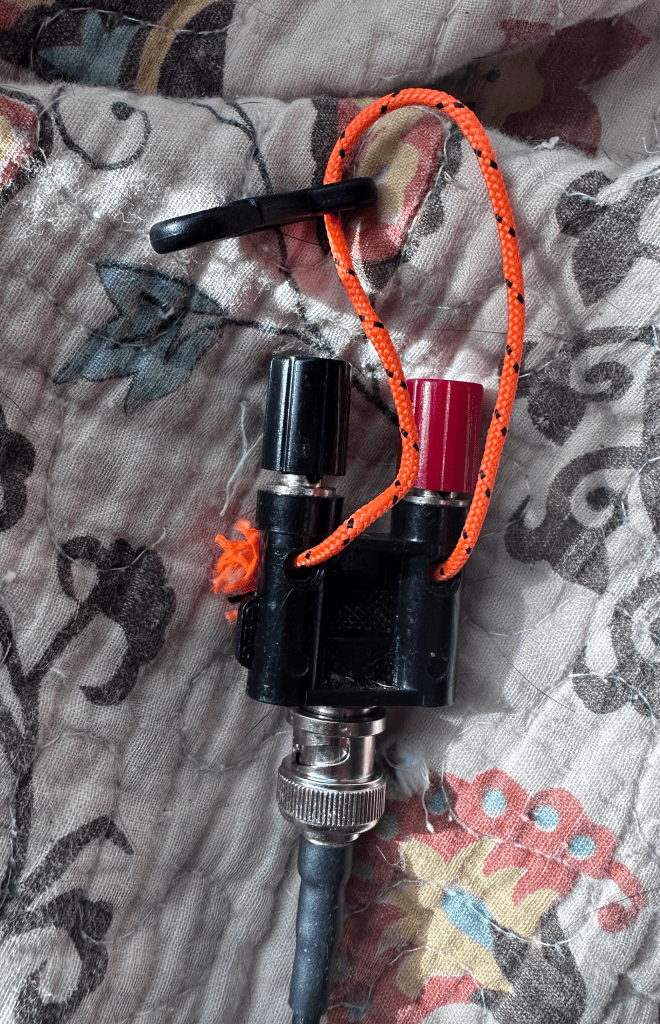
I cut a little long so of course it plotted low with my antenna analyzer. Doing the math 300/resonant freq – 300/desired freq I gradually snipped my way there. Yes, metric, don’t tell anybody. Once I got it close, I relied on the very precise method of, “I’ll lop off one cell phone’s width and see how it looks.” I basically blundered into a resonant point at 14.048. Well maybe not resonant – acceptable SWR (1.017:1 in this case).
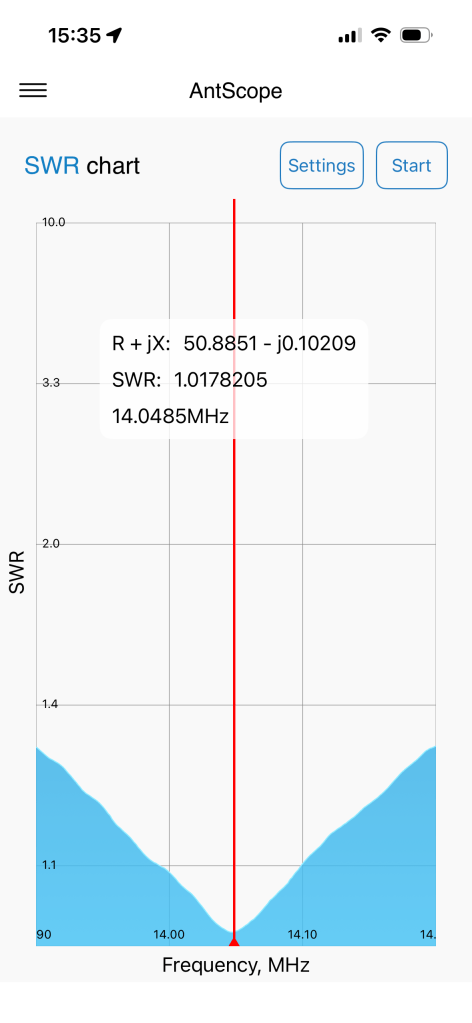
Just my take: Some hams are really impressed with their understanding that low SWR is not resonance. They tend to pedantically assert their intellectual superiority with words like inductive reactance and capacitive reactance and spout formulas for calculating imaginary states. I won’t argue with that one bit but here’s my knuckle dragging Jarhead perspective: Any watts trapped in a feedline don’t count.
Back to the dipole – I powered up my CFT1 on the porch and the first thing I noticed was how quiet it was. The normal sub-woofer of QRM in my yard was abnormally quiet and pleasant. I brought up Ham2K POLO on my phone and scrolled down the list of spots on 20 meters.
There were 17 activators spotted and while I couldn’t hear a few, every activator I heard, heard me. I even busted more than a few pile ups. Granted, I slid off the zero beat a few times to get heard but bust ‘em it did. 5 watts through a 20m inverted dipole with the center feed point up no more than 20 feet. I made 11 QSO in as many minutes.
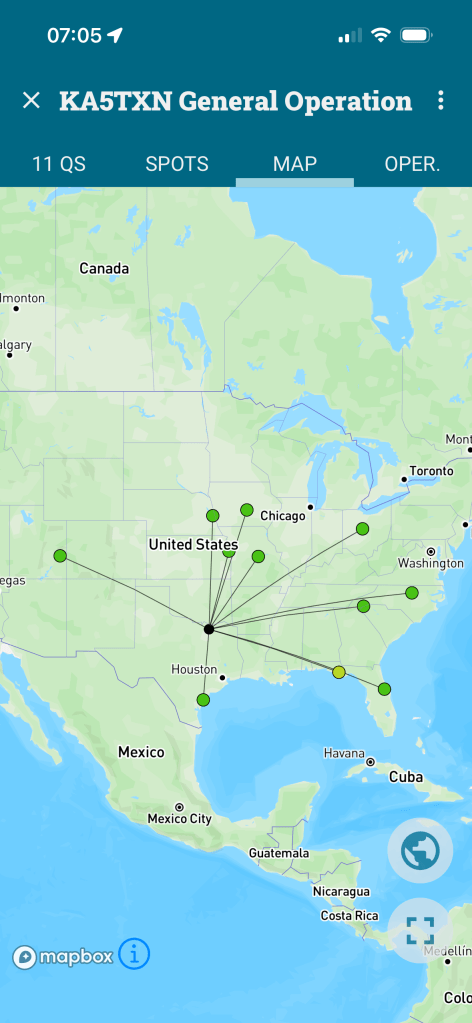
So, I’ll quit my gushing and giggling because we all know success is as much about the sun as it is about the antenna but by the all-knowing spirit of old guys, the dipole is certainly worth the squeeze.
Check my YouTube channel, I’ll try and show it on a video (Eventually).
https://www.youtube.com/@DitWitPortableRadio
TNX ES 73
KA5TXN
DitWit

 DitWit Portable Radio
Leave a comment